


Home service software integration should begin with one decision: which system owns each critical record. I want one authoritative place for customer identity, job status, payment status, marketing source, and communication consent before any apps exchange data. Without that ownership, faster syncing can spread duplicates, stale statuses, and bad attribution across the company.
This guidance is for established U.S. home-service companies using several cloud platforms in 2026. The exact security, privacy, payment, and messaging requirements depend on the data involved, the vendors selected, and applicable law.
Home service software integration starts with record ownership
A useful source of truth is the system the company accepts as authoritative for a particular field. It does not have to be one giant platform that stores everything.
For a plumbing company, the field-service system might own appointment and job status. Accounting might own recognized revenue and refunds. A call-tracking platform may preserve the original campaign and call recording. The website should capture the inquiry, but it should not become the permanent authority on whether the job sold.
I would assign an owner to at least five record groups:
- Customer identity: the canonical customer ID, name, phone, email, and service address.
- Operational status: requested service, appointment, technician assignment, estimate, cancellation, and completed job.
- Financial outcome: approved amount, invoice, payment, refund, and recognized revenue.
- Marketing origin: landing page, campaign identifiers, call source, and first known lead source.
- Communication permission: consent source, timestamp, channel, and opt-out status.
The owner should be specific enough to settle a disagreement. If the CRM says a job sold for $8,400 and accounting says $7,900 after a credit, the reporting rule needs to state which value is used and when it becomes final.
Map the job lifecycle before connecting the apps
The integration plan should follow the real customer journey from inquiry to collected revenue. A diagram of software logos is less useful than a list of business events, owners, and required fields.
Consider an HVAC replacement lead. A homeowner calls from an ad, dispatch creates the customer, an estimator runs the appointment, the estimate is revised, financing is approved by a third party, the installation is completed, and accounting records the final payment. Six platforms may touch that job. The integration succeeds only if the company can trace the same opportunity through each important transition.
Keep one durable identifier through the journey
A durable internal lead or job ID prevents a phone number or email address from carrying the entire matching burden. People share phone numbers, mistype email addresses, move, and contact the company more than once. The original campaign identifiers should be stored alongside the internal ID rather than replacing it.
Google’s current enhanced conversions for leads documentation requires a website lead field that can also appear in the later offline import. Google recommends continuing to include click IDs when possible. That is a practical example of why identifiers must survive the handoff between the website, office, CRM, and advertising account.
Move business outcomes instead of copying every field
A strong integration sends the smallest useful set of events and fields. Copying every available record into every platform raises the maintenance burden and expands the number of places where customer information can become stale.
I would begin with a short event contract:
- New inquiry created
- Qualified appointment booked
- Appointment kept or estimate completed
- Job sold, completed, canceled, or refunded
Each event needs a definition, timestamp, owner, unique ID, and correction rule. “Booked” should not mean scheduled in one branch and completed in another. A cancellation should update the earlier appointment instead of creating a second contradictory record.
Revved’s guide to sending booked-job outcomes back to Google Ads explains why a phone call alone is an incomplete optimization signal. The same discipline applies throughout the stack: downstream systems should receive the outcome the office can defend.
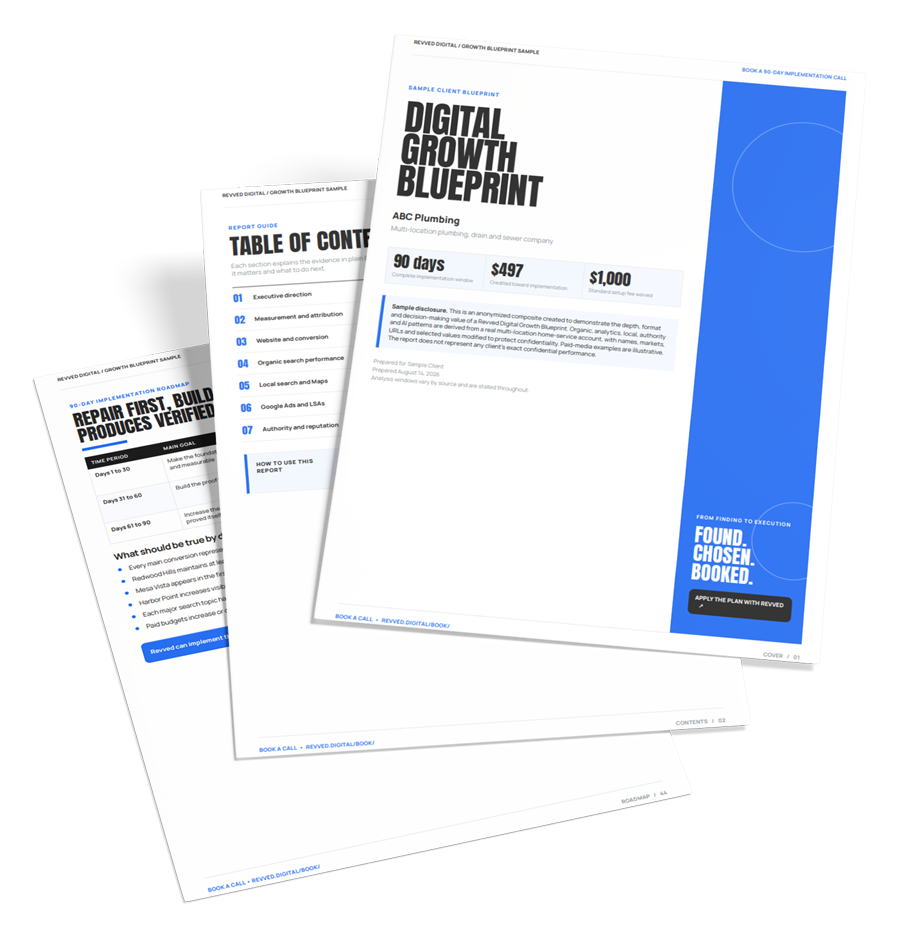
If the website, advertising, call handling, and CRM cannot be reconciled cleanly, a website and visibility audit can identify where the customer path and measurement break before another connection is added.
Build failure rules before turning on automation
Every home service software integration needs an explicit response to missing, delayed, and conflicting data. “The apps are connected” says nothing about what happens when an API is unavailable or a dispatcher corrects a record after the first sync.
I would document five failure rules:
- Duplicate rule: define how phone, email, address, and internal IDs are used to detect a likely duplicate.
- Update rule: state which system wins when the same field changes in two places.
- Retry rule: set a retry window and a visible failure queue rather than silently dropping records.
- Reversal rule: decide how cancellations, refunds, reopened jobs, and estimate revisions correct earlier events.
- Ownership rule: name the person who reviews exceptions and the time allowed to resolve them.
Silent failure is the dangerous condition. A simple daily exception list is often more valuable than another dashboard because it shows the records that did not reach their destination.
Protect customer information while it moves
Integration design is also data-security design. The U.S. Federal Trade Commission advises businesses to inventory personal information, keep only what they need, protect it, dispose of it properly, and plan for incidents. Its business guide also recommends tracing how personal information moves through the company and identifying who can access it.
In practice, I would avoid sending payment details, financing documents, call recordings, or full customer notes to a platform that only needs an event name and job ID. Limit service-account permissions, remove former employees promptly, review vendor access, and document retention. Hashing a field for an advertising connection does not remove the need to handle the original customer data responsibly.
Critical records also need a recovery plan. The Cybersecurity and Infrastructure Security Agency’s ransomware guidance recommends separate, encrypted backups and regular recovery testing. A contractor should confirm which vendor can export the customer, job, and financial records needed to operate if a platform or connection fails.
Test the integration with real job scenarios
A software connection should be accepted with complete scenarios, not a successful test record. I would run one normal job and several exceptions before trusting production reporting.
The test set should include a duplicate caller, an out-of-area lead, a rescheduled appointment, a canceled estimate, a partial refund, a customer with no email address, and two jobs for the same property. For each case, compare the source record, destination record, timestamps, revenue, consent status, and marketing identifiers.
Google’s 2026 guidance for offline lead data gives a useful transition model: validate the new conversion flow, allow data to accumulate, review diagnostics, and only then replace the older action. The same cautious overlap is appropriate for a new CRM or automation. Run old and new reporting together long enough to explain meaningful differences before retiring the old path.
When a manual handoff is the better choice
Not every connection deserves automation. A low-volume event with a high consequence may be safer as a controlled weekly import or human review. Financing approvals, disputed invoices, large refunds, and unusual commercial jobs often need judgment that a generic workflow cannot supply.
I would automate only after the team can perform the process consistently by hand. If nobody agrees on when a lead becomes qualified, connecting the CRM to five reporting systems will make the disagreement harder to see.
Choose one owner for every field that matters
The actionable takeaway is a one-page ownership map. List each critical field, its authoritative system, the systems allowed to read it, the events allowed to change it, the correction rule, and the employee responsible for exceptions. Then connect only the fields and outcomes required for the next business decision.
For established trades companies ready to connect visibility, conversion, advertising, reporting, and follow-up as one operating system, review Revved’s connected Growth Kit implementation.